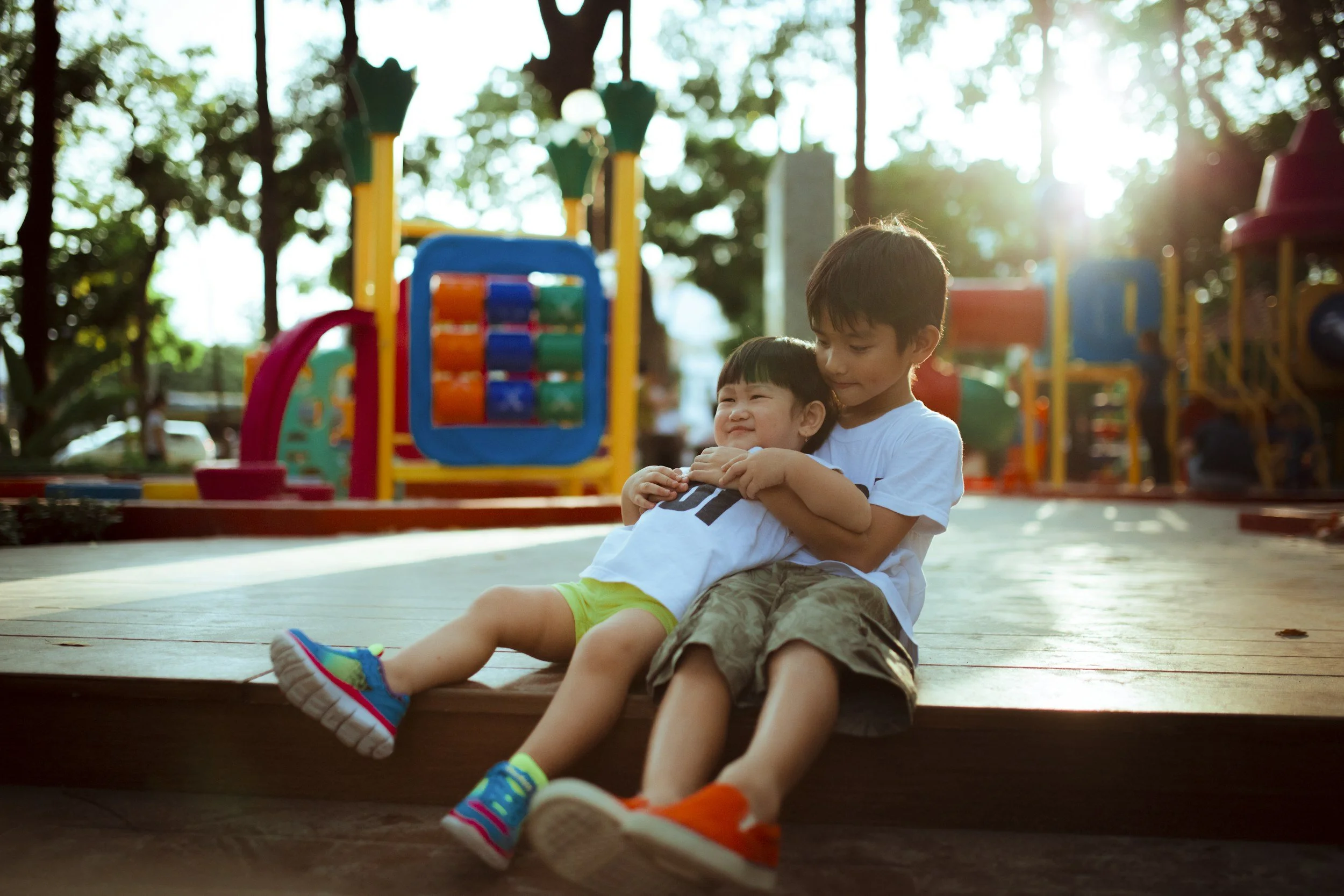
When the Second Baby Arrives, the First One Loses Their World. Here's How to Help — and Why You Might Need Support Too.
Perinatal Mental Health · Parenting · Family Therapy · California
You imagined them playing together. Laughing. Looking out for each other. What you probably didn't fully anticipate was the hitting, the regression, the "I hate the baby," the older one suddenly unable to do things they'd been doing independently for months. Or the guilt you'd feel watching your firstborn reckon with no longer being the only one.
If you're in the thick of this right now — a toddler or preschooler and a new baby, or two young children who seem constitutionally incapable of sharing a room without someone crying — this post is for you. Not with tips to make it stop, but with a framework for understanding what's happening, and why your own experience of it matters just as much as theirs.
What your older child is really going through
When a new baby arrives, the older child doesn't experience it as an addition to the family. They experience it as a displacement. The undivided world they knew — your attention, your lap, your gaze — has been restructured around someone else's needs. And they had no say in it.
In their landmark book Siblings Without Rivalry, therapists Adele Faber and Elaine Mazlish offer an analogy that has stayed with parents for decades: imagine your partner coming home and announcing they've brought home a second spouse. "You're going to love them," they say. "And you'll have so much fun together once they get a little older." The feelings that would arise — the jealousy, the confusion, the grief, the rage — are not so different from what a toddler is living when the baby comes home.
This isn't a reason to feel guilty. It's a reason to take your older child's adjustment seriously, and to resist the instinct to manage or minimize what they're feeling. The child who says "I hate the baby" or "put it back" is not a problem child. They are a child with enormous feelings and very few words for them.
Feelings that are acknowledged tend to lose their intensity. Feelings that are dismissed tend to come out sideways — usually on the baby, or on you.
What children need most: to be seen, not fixed
One of the most powerful things a parent can do in the middle of sibling conflict is resist the urge to adjudicate. Who started it, who had it first, who is right — these questions are almost always less important than the feelings underneath them. When a child is hitting or screaming or sobbing, they are not primarily a behavior to be corrected. They are a nervous system in overwhelm, looking for a regulated adult to help them find their way back.
Faber and Mazlish are clear on this: children don't need us to solve their conflicts for them — at least not most of the time. They need us to name what they're feeling, hold the space without taking sides, and trust that the relationship between siblings is something they are capable of building themselves, with support. When we rush to fix, we inadvertently communicate that the feelings aren't tolerable — and that the children can't be trusted to work through them.
This doesn't mean permitting harm. It means distinguishing between feelings, which are always allowed, and behaviors, which have limits. A child can hate the baby. A child cannot bite the baby. These two things can be true at the same time, held with the same calm.
The role of connection — and why it's harder than it sounds
What underlies most sibling conflict in young children is a bid for connection — specifically, a bid for your connection. The toddler who ramps up the moment you sit down to nurse isn't trying to make your life difficult. They are trying to tell you something about what they need, in the only language available to them at that developmental stage.
Psychologist Kim John Payne, in The Soul of Discipline, grounds this observation in attachment science: children behave best when they feel most connected. This sounds simple but is hard to practice when you are sleep-deprived, touched out, and managing two small people's needs simultaneously. The discipline that actually works — not compliance through fear or shame, but cooperation through relationship — is rooted in this understanding. Consequences and correction land differently on a child who feels securely held than on one who is already running a deficit.
Small, consistent moments of one-on-one connection with your older child — even five or ten minutes of fully present, child-led play — can shift the emotional temperature of an entire day. Not because it solves the structural problem of having a new sibling, but because it communicates: you are still seen. You still matter. Nothing has replaced you.
You cannot pour from an empty cup — and you also cannot offer the kind of regulated, connected presence your children need if you yourself are running on nothing.
What this brings up in parents
Here is something that doesn't get talked about enough: watching your children struggle with each other, or watching your older child grieve the loss of their only-child world, activates something in parents that isn't always easy to identify or name.
For some parents, sibling conflict triggers their own childhood material — old memories of feeling unseen, of being compared to a brother or sister, of never quite getting what they needed. The child who reminds you of yourself at that age, or the dynamic between your kids that echoes something from your own family of origin, can pull you out of the present moment and into a much older story without you realizing it.
For others, the guilt is the loudest thing. Guilt about having another baby and disrupting the older child's world. Guilt about not being able to give each child everything they need. Guilt about the moments you lose patience, raise your voice, take sides, or simply disappear into the bathroom for sixty seconds of silence and come out to find chaos.
And for almost all parents of young children in this season: the sheer physical and emotional depletion of managing two small people whose needs are constant and whose capacity for self-regulation is, by definition, still developing.
Why therapy can help — and why it's for you, not just your kids
Parents often come to therapy looking for strategies. What do I do when they fight? How do I stop the hitting? How do I get my toddler to stop waking the baby? These are real questions and they deserve real answers.
But the most transformative work that happens in therapy for parents of young children is usually less about technique and more about the parent's own interior experience. What is this bringing up for me? Where am I getting pulled out of the present? What story am I telling myself about what my child's behavior means — about them, and about me as a parent?
Somatic and attachment-informed approaches are particularly well-suited here, because so much of what gets activated in parenting lives below the level of conscious thought. The surge of anger when the toddler hits the baby again. The way your body braces when you hear crying start up in the next room. The grief, quiet and persistent, that this season is harder than you thought it would be. These aren't thoughts to be reframed — they're experiences to be processed, with support.
Therapy also offers a space to grieve the relationship you had with your firstborn before the baby came — the ease, the simplicity, the version of yourself as a parent that you knew how to be. That loss is real, even if nobody names it. Even if your older child is thriving. Even if you love your new baby fiercely. Transitions cost something. You're allowed to feel the cost.
What you're building, even when it doesn't look like it
The sibling relationship your children are forming right now — in the hitting and the crying and the "that's mine" and the occasional, astonishing moments of tenderness — is one of the longest relationships of their lives. Research on sibling dynamics consistently shows that the early years, however chaotic, are laying the foundation for something that will matter to them for decades.
You are not failing because it's hard. You are in the middle of two children learning, slowly and messily, how to share a world. Your job is not to make that process smooth. Your job is to stay present enough, regulated enough, and connected enough to be the container they need while they figure it out.
That is an enormous job. It deserves support.
Ready to talk?
I'm Eve Arbel, a Licensed Marriage and Family Therapist in California specializing in motherhood, parenting, and family wellness. I work with individuals and couples via telehealth, anywhere in California.
If this resonated, I'd love to support you on your journey. Schedule a free consultation to explore working together.